Notion earned its place as the default workspace, but the complaints that fill r/macapps threads are consistent: it is slow to open, weak offline, and your notes live in Notion's format on Notion's servers. The good news is that the exodus paths are well worn by now. Four apps cover the four main reasons people leave — and we track all of them on our Notion alternatives page.
If you want to own your notes forever: Obsidian
Obsidian stores everything as plain Markdown files on your Mac. No export step, no proprietary format — a folder of text files that will open in anything, decades from now. Backlinks and the graph view turn that folder into a real knowledge base, and the plugin ecosystem covers everything from Kanban to spaced repetition.
The catch: databases are a plugin, not a first-class feature. If Notion's tables are your workflow, look at Anytype instead. Otherwise, this is the default answer for a reason — free for personal use, with optional $4/month sync (or use iCloud for nothing).
If you want Notion's structure without Notion's servers: Anytype
Anytype is the closest structural clone — objects, relations, templates, databases — rebuilt local-first with end-to-end encryption and peer-to-peer sync. It is the recommendation that keeps appearing in privacy-focused threads, because it does not ask you to give up the databases that keep most people stuck in Notion.
The catch: it is younger than everything else here, and the sync model takes a little adjusting to. Open source and free for personal use.
If Notion just feels like too much: UpNote
UpNote is the switch for people who realised they were using a database engine to write shopping lists. Notebooks, nested notes, templates and reliable sync in an app that opens instantly. The $39.99 lifetime licence is the quiet star — in a category drowning in subscriptions, you pay once.
The catch: no databases, no kanban, no API. That is the point.
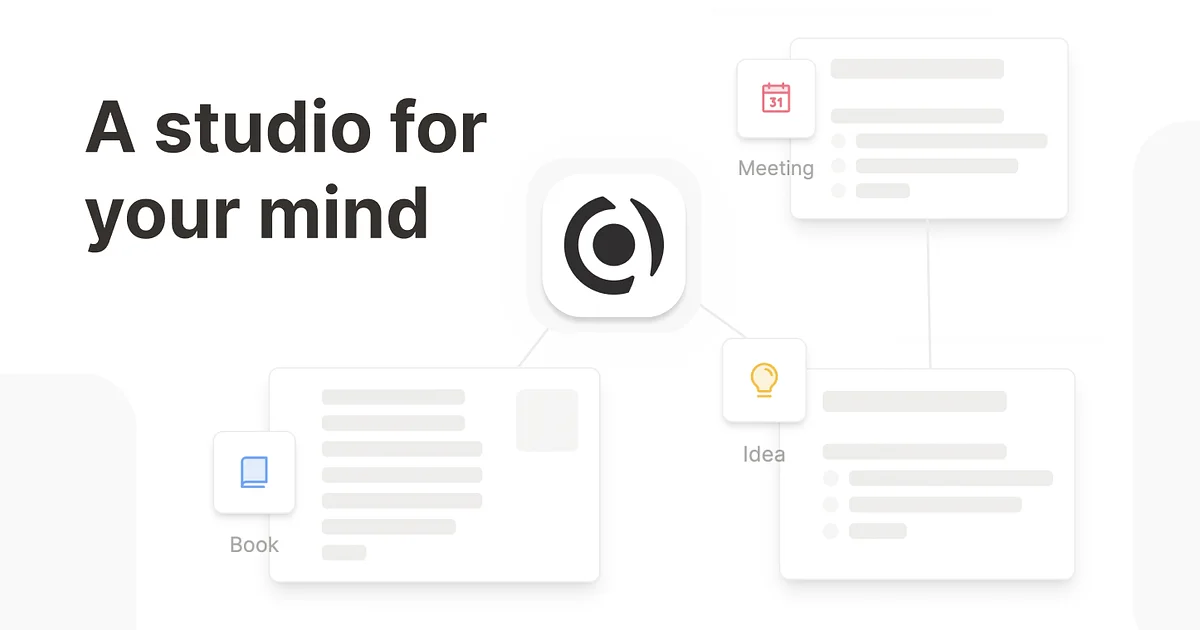
If you liked the idea of databases more than the reality: Capacities
Capacities keeps Notion's best idea — typed objects with properties — and builds the whole app around it. People, meetings, books and ideas each get a type, and the app links them into a networked knowledge base without you maintaining table views.
The catch: collaboration is thinner than Notion's; this is a personal tool first. Free with a generous cap, Pro at $11.99/month.
The honest summary
Obsidian for longevity, Anytype for privacy with structure, UpNote for simplicity at a fair price, Capacities for structure without sprawl. All four are on the Notion alternatives page, and the wider productivity category has plenty more where these came from.